
What Coolant Does My Car Need? Colour Doesn't Tell You
Find out what coolant your car needs, why colour can mislead, whether you can mix coolants and how to top up safely.
What Coolant Does My Car Need? A Complete UK Guide to Choosing the Right Antifreeze
If you're asking "what coolant does my car need?", the safest answer is: the coolant specified by your vehicle manufacturer. Not the one your neighbour uses. Not the one that happens to be on offer. And definitely not just "the pink one", because coolant colour is about as reliable as judging a car's service history by how shiny the tyres are.
Engine coolant, also called antifreeze, is vital for keeping your engine at the correct temperature. It helps prevent overheating in summer, freezing in winter and corrosion inside the cooling system. Use the wrong type, or mix incompatible coolants, and you can cause sludge, blocked passages, corrosion and expensive engine damage.
This guide explains how to find the correct coolant for your car, what the different coolant types mean, whether you can mix them and how to top up safely.
Quick Answer: What Coolant Does My Car Need?
Your car needs the coolant that matches the manufacturer's specification in the owner's handbook or service information. You can usually find the correct coolant by checking your handbook, using a registration-based parts lookup tool or asking a reputable garage or dealer. Do not rely on colour alone, because different coolant types can share similar colours.
Useful sources: RAC antifreeze guide, Halfords antifreeze guide and your vehicle manufacturer's handbook.
What Does Coolant Do?
Coolant is a liquid that circulates around the engine and cooling system to control temperature.
It helps to:
- Prevent the engine overheating
- Stop the cooling system freezing in cold weather
- Protect metal parts from corrosion
- Lubricate parts such as the water pump
- Maintain stable engine temperature
- Support heating inside the cabin
- Protect radiators, hoses, seals and thermostats
Most modern coolant is a mixture of antifreeze concentrate and water. The antifreeze part usually contains glycol and additives that protect against freezing, boiling and corrosion.
Without proper coolant, an engine can overheat rapidly. That is not a small problem. Overheating can damage head gaskets, cylinder heads, radiators, hoses and other parts that are rarely cheap or cheerful.
Is Coolant the Same as Antifreeze?
Not quite.
The terms are often used interchangeably, but technically:
| Term | Meaning |
|---|---|
| Antifreeze | Concentrated chemical fluid before dilution |
| Coolant | Ready-to-use mixture of antifreeze and water |
| Ready-mixed coolant | Pre-diluted coolant you can usually pour straight in |
| Concentrate | Must be diluted correctly before use |
Many bottles sold in shops are ready-mixed coolant. Others are concentrated antifreeze that must be mixed with water, often deionised or distilled water depending on the product instructions.
Always read the label. Pouring neat concentrate into some systems, or diluting something that is already ready-mixed, can create problems.
How Do I Find the Right Coolant for My Car?
There are several sensible ways to check.
1. Check Your Owner's Manual
The vehicle handbook is the best starting point. It should list the required coolant specification, sometimes using manufacturer codes.
Examples might include specifications from brands such as Volkswagen, Ford, BMW, Mercedes-Benz, Toyota, Honda, Hyundai or Stellantis.
The key is the specification, not the colour.
2. Use a Registration-Based Lookup Tool
Many UK parts retailers allow you to enter your registration number to identify compatible coolant.
This is useful, but still check the product details carefully. Registration lookups are helpful, not infallible.
3. Ask a Dealer or Specialist Garage
If you are unsure, contact a main dealer, trusted independent garage or specialist parts supplier.
This is especially wise for:
- Newer vehicles
- Hybrids
- Electric cars
- Performance cars
- Imported vehicles
- Cars with unknown service history
- Cars where the coolant has already been mixed or contaminated
4. Check the Coolant Bottle Specification
If topping up with a product from a shop, check the label against your manufacturer's required specification.
Do not simply buy "red coolant" because your current coolant looks red. That is how cooling systems end up full of chemical soup.
Why Coolant Colour Can Be Misleading
Coolant colour can provide a rough clue, but it is not a reliable way to choose the right coolant.
You may see coolant in:
- Blue
- Green
- Red
- Pink
- Orange
- Purple
- Yellow
Different manufacturers use different dyes, and aftermarket brands may colour similar coolant types differently. Two coolants of the same colour can use different additive technologies. Two different colours can sometimes meet the same specification.
So yes, colour helps you spot obvious changes or contamination, but it should not be used as the final decision.
Main Types of Car Coolant
Coolant formulations vary, but most fall into broad families.
IAT Coolant
IAT stands for Inorganic Additive Technology.
It is more commonly associated with older vehicles and traditionally used silicate-based corrosion inhibitors. It usually has a shorter service life than newer coolant types.
Typical use:
- Older cars
- Some classics
- Vehicles built before many modern long-life coolant systems
OAT Coolant
OAT stands for Organic Acid Technology.
It is widely used in many modern cars and is often designed to last longer than older coolant types. Many post-1990s and modern vehicles use OAT-based coolants, but you should still check the exact manufacturer specification.
Typical use:
- Many modern petrol and diesel cars
- Longer-life cooling systems
- Aluminium-heavy engine designs
HOAT Coolant
HOAT stands for Hybrid Organic Acid Technology.
It combines organic acid technology with other additives and is used by various manufacturers. Some European and Asian vehicles use HOAT or related hybrid formulations.
Typical use:
- Manufacturer-specific cooling systems
- Vehicles needing hybrid corrosion protection
- Some modern European and Asian cars
Si-OAT and Other Manufacturer-Specific Coolants
Some modern cars use more specialised coolant formulations, including silicated OAT coolants and brand-specific specifications.
This is especially common on newer vehicles where engines, radiators, seals, plastics and cooling systems are designed around particular chemical protection.
Again, the manufacturer specification wins.
Can You Mix Different Coolants?
As a general rule, you should avoid mixing different coolant types unless the product specifically says it is compatible.
Mixing incompatible coolants can:
- Reduce corrosion protection
- Create sludge or gel-like deposits
- Block coolant passages
- Damage seals or water pumps
- Cause overheating
- Shorten coolant life
If you do not know what coolant is already in the car, it is often safer to have the system drained, flushed and refilled with the correct coolant.
That may sound like overkill, but it is cheaper than replacing parts after the cooling system has been turned into a chemistry experiment.
Can You Top Up Coolant with Water?
In an emergency, plain water may be used temporarily to help get you safely to a garage, but it is not a proper long-term solution.
Water alone does not provide the same:
- Freeze protection
- Boil protection
- Corrosion resistance
- Lubrication for water pump components
If you have topped up with water, have the coolant strength and mixture checked as soon as possible.
Repeatedly topping up with water can dilute the coolant and reduce protection, especially during winter.
Ready-Mixed Coolant vs Concentrate
When buying coolant, you will usually see two options.
| Type | What It Means | Best For |
|---|---|---|
| Ready-mixed coolant | Already diluted to the correct ratio | Simple top-ups |
| Concentrated antifreeze | Needs mixing with water | Full coolant changes or workshop use |
Ready-mixed coolant is easier for most drivers because it removes the guesswork.
Concentrate can be useful if you are changing the coolant fully, but you must mix it correctly. Many products use a 50:50 mixture with water, but not all. Follow the label and your vehicle handbook.
How to Check Your Coolant Level
Only check coolant when the engine is cool.
- Park on level ground.
- Open the bonnet.
- Find the coolant expansion tank.
- Look for the minimum and maximum level marks.
- The coolant should sit between those marks.
- If low, top up with the correct coolant.
- Refit the cap securely.
GOV.UK's "show me, tell me" driving test guidance teaches learners to identify the high and low markings on the header tank or radiator filler cap and explain how to top up to the correct level.
Useful source: GOV.UK car "show me, tell me" vehicle safety questions.
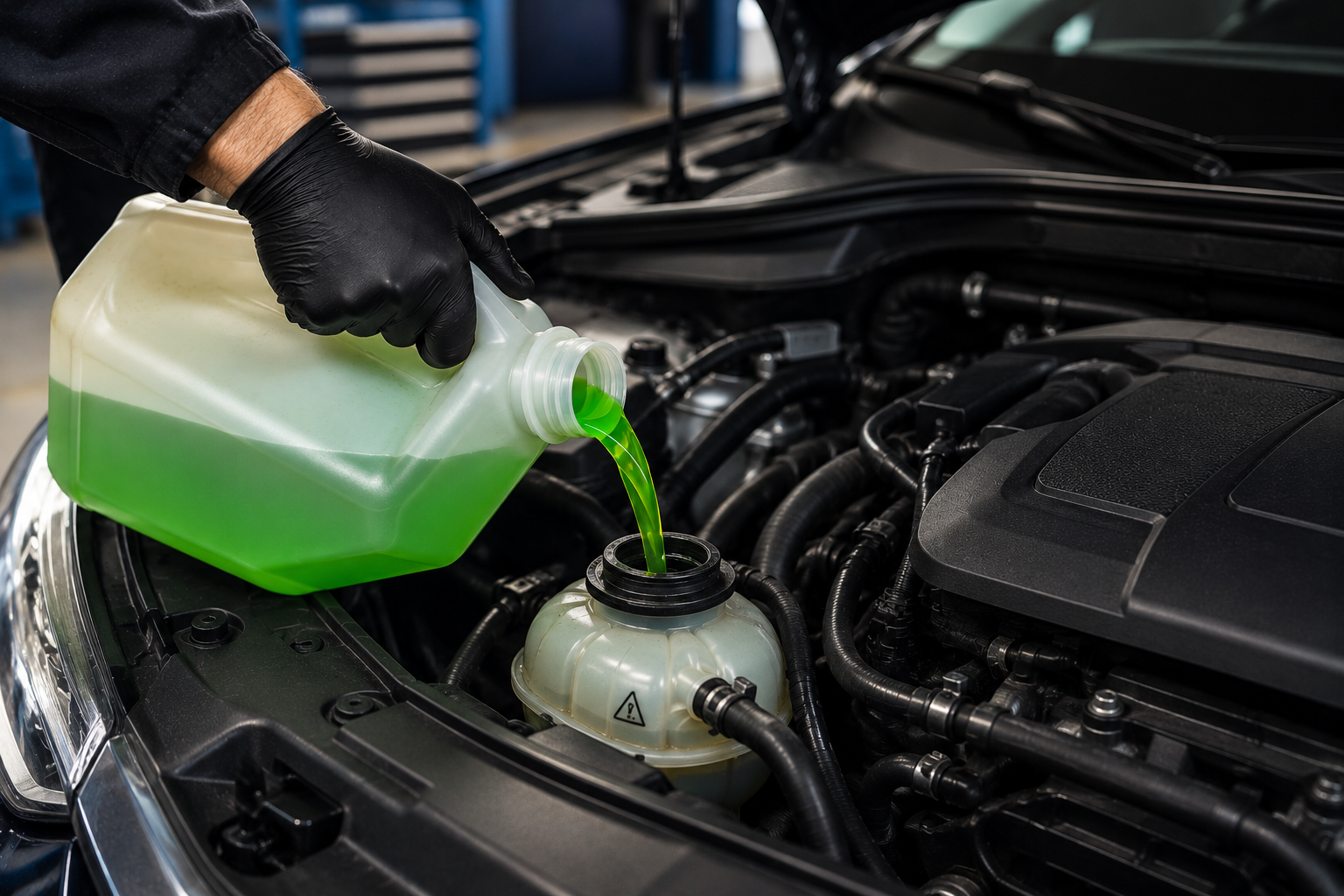
How to Top Up Coolant Safely
Topping up coolant is simple, but there is one crucial rule: do not open the coolant cap when the engine is hot.
A hot cooling system is pressurised. Remove the cap too soon and you risk being sprayed with scalding coolant. This is not character-building; it is dangerous.
Follow these steps:
- Switch off the engine.
- Let the engine cool fully.
- Put on gloves if available.
- Slowly open the coolant cap.
- Add the correct coolant to the maximum mark.
- Do not overfill.
- Tighten the cap properly.
- Check for leaks after driving.
If your engine has overheated, the Highway Code says to wait until it has cooled naturally before removing the coolant filler cap and adding water or coolant.
Useful source: GOV.UK Highway Code Annex 6 vehicle maintenance guidance.
How Often Should Coolant Be Changed?
Coolant change intervals vary widely.
Some older vehicles may need coolant replacement every two or three years. Many modern long-life coolants can last around five years or longer, depending on the vehicle and coolant type.
Your owner's manual or service schedule should tell you the correct interval.
Do not assume coolant lasts forever. Its corrosion inhibitors weaken over time, even if the level looks fine.
Signs Your Car Has the Wrong Coolant or a Cooling Problem
Watch for:
- Engine temperature warning light
- Rising temperature gauge
- Low coolant level
- Frequent need to top up
- Visible leaks under the car
- Sweet smell around the engine bay
- Steam from the bonnet
- Heater blowing cold air
- Rusty, cloudy or oily coolant
- Sludge in the coolant tank
- White exhaust smoke
- Milky residue under the oil filler cap
Some of these signs can point to serious problems such as head gasket failure, radiator leaks, water pump failure or coolant contamination.
If the car is overheating, stop safely and do not keep driving. Engines do not "walk it off".
Is Coolant Checked During an MOT?
An MOT is not a service, and it does not replace coolant maintenance.
The MOT test checks minimum roadworthiness and emissions standards on the day of the test. It is not designed to confirm that your coolant is the correct type, strength or age.
A serious leak or defect may cause MOT issues depending on where it is and how it affects safety, but you should not rely on an MOT to tell you whether your cooling system is healthy.
If your MOT is due and your car has been overheating, get the problem investigated before the test.
Need to check your vehicle's roadworthiness record? Check your MOT history here.
Do Electric Cars Need Coolant?
Many electric cars and hybrids use coolant too.
Instead of only cooling a combustion engine, coolant may help manage temperature for:
- Battery packs
- Electric motors
- Inverters
- On-board chargers
- Hybrid engine systems
- Cabin heating systems
EV and hybrid cooling systems can be specialised and may require manufacturer-approved coolant. Do not use ordinary coolant unless it clearly meets the correct specification.
High-voltage systems should be left to trained technicians. This is not the place for brave improvisation with a funnel.
Should You Flush the Cooling System?
A coolant flush may be needed if:
- The wrong coolant has been added
- Different coolant types have been mixed
- Coolant is rusty, dirty or sludgy
- The vehicle has overheated
- The manufacturer's change interval is due
- The car has an unknown service history
A proper flush removes old coolant and contamination before refilling with the correct type.
For many modern vehicles, it is best done by a garage, especially if the system needs bleeding properly to avoid air locks.
Common Mistakes to Avoid
Avoid these:
- Choosing coolant by colour alone
- Mixing unknown coolant types
- Opening the coolant cap when hot
- Using water as a long-term replacement
- Overfilling the expansion tank
- Ignoring repeated coolant loss
- Using universal coolant without checking specification
- Forgetting EVs and hybrids may need specific coolant
- Assuming a passed MOT means the cooling system is fine
The cooling system is not glamorous, but it is extremely important. Ignore it and your engine may respond with steam, warning lights and a bill large enough to have its own postcode.
FAQs
What coolant does my car need?
Your car needs the coolant specified by the manufacturer in the owner's manual or service information. Use the specification, not just the colour, to choose the correct coolant.
Can I use any coolant in my car?
No. Different cars require different coolant formulations. Using the wrong coolant or mixing incompatible types can cause corrosion, sludge, overheating and damage.
Does coolant colour matter?
Colour can be a rough clue, but it is not reliable. Always check the manufacturer specification because different coolant types can share similar colours.
Can I mix pink and blue coolant?
You should not mix coolants unless the product specifically states they are compatible and meet your vehicle's required specification. If unsure, get the system checked or flushed.
Can I top up coolant with water?
In an emergency, water can be used temporarily, but it should not be treated as a proper long-term coolant. It lacks antifreeze and corrosion protection.
How do I know if my coolant is low?
Check the coolant expansion tank when the engine is cold. The level should sit between the minimum and maximum marks.
Why does my coolant keep disappearing?
Repeated coolant loss usually means there is a leak or internal engine problem. Check hoses, radiator, water pump and expansion tank, and get a garage inspection if the level keeps dropping.
Should I use ready-mixed coolant or concentrate?
Ready-mixed coolant is easiest for top-ups. Concentrate must be diluted correctly before use, usually with deionised or distilled water depending on the product instructions.
Do electric cars need coolant?
Many electric and hybrid vehicles use coolant for battery, motor or electronic temperature control. Always use the manufacturer-approved coolant.
Is coolant checked in a service?
A service usually includes coolant level and condition checks, but the exact checklist varies by garage and service type. Always confirm what is included when booking.
Conclusion
The right coolant for your car is the one that matches the manufacturer's specification. Colour alone is not enough, and mixing random coolants is a gamble your cooling system may not appreciate.
Check your handbook, use a trusted registration lookup, or ask a reputable garage before topping up. If you are unsure what is already in the system, or the coolant looks dirty, low or contaminated, have it inspected properly. Coolant is cheap compared with engine damage, which is exactly the sort of sentence that sounds dull until you are staring at a repair estimate.