
Why Do MOT Tests Include an Exhaust Emissions Test?
MOT tests include an exhaust emissions test to check that vehicles meet legal environmental standards and are not producing excessive pollution or smoke. Find out what petrol and diesel cars are checked for, and why emissions can cause an MOT fail.
Why Do MOT Tests Include an Exhaust Emissions Test?
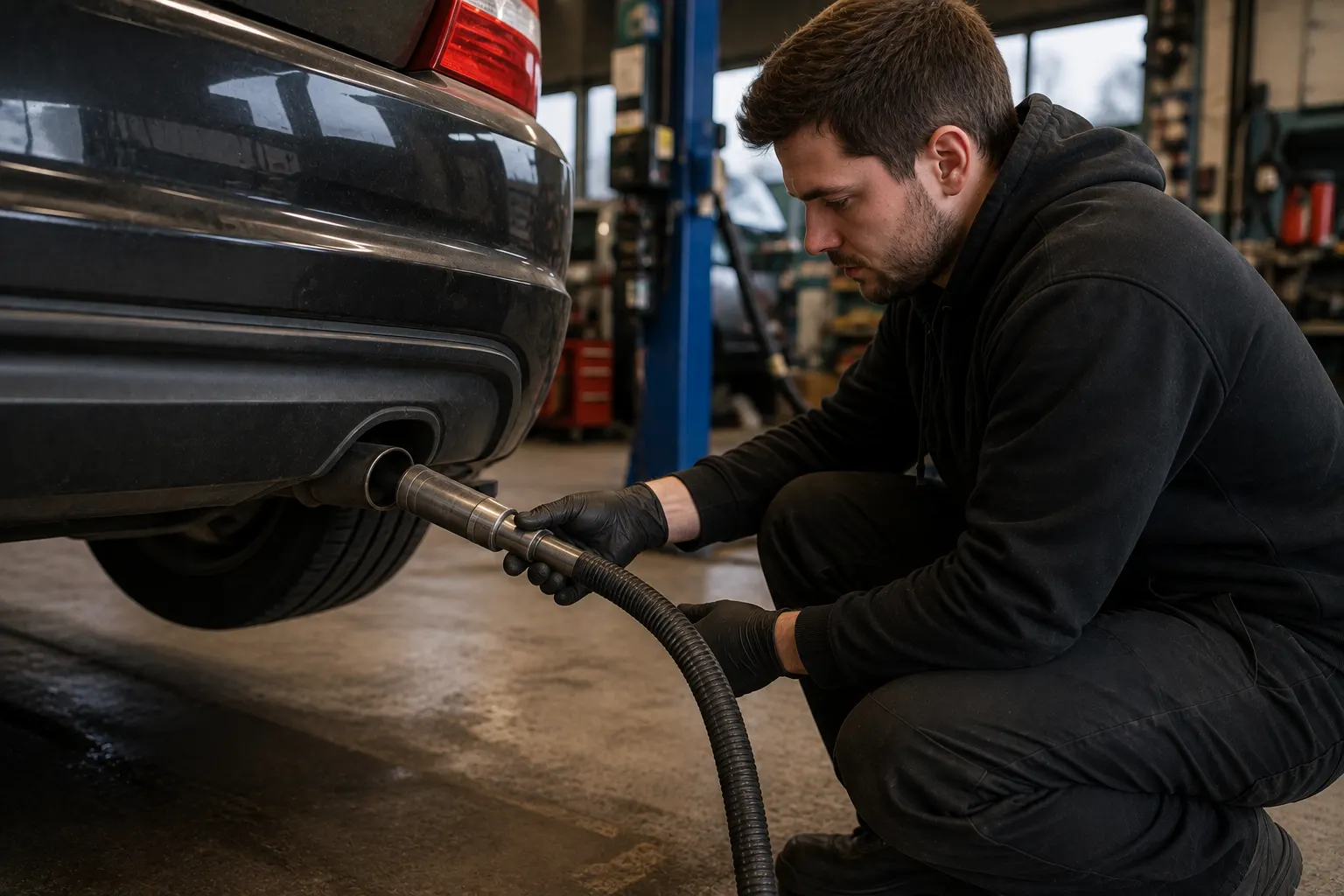
MOT tests include an exhaust emissions test because the MOT is not only about whether a car can stop, steer and keep its lights on. It also checks whether the vehicle meets minimum environmental standards.
A car that produces excessive exhaust emissions can affect air quality, public health and the environment. It can also be a sign that something is wrong with the engine, fuel system, exhaust, catalytic converter, diesel particulate filter, oxygen sensor or other emissions-control equipment.
That is why emissions are part of the MOT. The test helps catch vehicles that are producing too much smoke or pollution, have faulty emissions systems, or have missing or tampered emissions-control parts.
The MOT emissions test is not a full laboratory emissions test. It does not measure every pollutant in every real-world driving condition. It is a practical roadworthiness and environmental check designed to stop obviously defective or badly polluting vehicles being used on the road.
Quick Answer: Why Do MOT Tests Include an Exhaust Emissions Test?
MOT tests include an exhaust emissions test to check that vehicles meet legal environmental standards and are not producing excessive pollution or smoke. Petrol vehicles are usually checked for exhaust gases such as carbon monoxide and hydrocarbons, while diesel vehicles are usually checked for smoke opacity. A vehicle can fail if emissions are too high or required emissions-control equipment is missing, defective or tampered with.
What Is the Purpose of the MOT Emissions Test?
The purpose of the MOT emissions test is to check that a vehicle’s exhaust output is within the rules for its age, fuel type and emissions standard.
In simple terms, it helps answer three questions:
- Is the vehicle producing too much pollution?
- Is the emissions system working properly?
- Has important emissions equipment been removed, damaged or tampered with?
A modern car is designed to control exhaust gases before they leave the tailpipe. If that system stops working properly, the car may still drive normally but produce much higher emissions.
That is the problem the MOT emissions test is trying to catch.
Why Are Exhaust Emissions Included in the MOT?
Exhaust emissions are included because a vehicle can be unsafe for the environment even if it appears mechanically usable.
A car might start, drive and brake normally, but still have:
- Excessive exhaust smoke
- High carbon monoxide
- High hydrocarbons
- A faulty catalytic converter
- A missing catalyst
- A removed or tampered DPF
- A serious exhaust leak
- An engine management fault
- Poor combustion
- Emissions-control equipment that is missing or defective
These problems can make the vehicle more polluting than it should be.
The MOT is designed to check minimum road safety and environmental standards. That is why exhaust emissions sit alongside checks such as brakes, tyres, lights, steering and suspension.
A car that cannot stop properly is a safety problem. A car pouring out smoke is an environmental and visibility problem. Both matter.
What Does the MOT Emissions Test Check?
The exact emissions check depends on the vehicle’s fuel type, age and emissions standard.
The MOT may check:
- Exhaust gas readings
- Smoke level
- Emissions-control equipment
- Engine management warning light
- Exhaust leaks
- Missing catalytic converter
- Missing or tampered diesel particulate filter
- Excessive visible smoke
- Whether the exhaust is secure and complete
The test is not identical for every vehicle. Petrol, diesel, hybrid, older, imported and modified vehicles can be treated differently depending on the rules that apply to them.
For most drivers, the simple version is this: the tester checks whether the vehicle is producing emissions or smoke above the permitted limit, and whether important visible emissions equipment is present and not obviously defective.
Petrol Cars: What Gets Checked?
Petrol cars are usually checked using an exhaust gas analyser.
Depending on the age and specification of the vehicle, the MOT may measure:
- Carbon monoxide
- Hydrocarbons
- Lambda reading, where applicable
High carbon monoxide or hydrocarbon readings can suggest poor combustion or a problem with the engine or emissions system.
A petrol car may fail its emissions test because of:
- Faulty catalytic converter
- Missing catalytic converter
- Faulty oxygen sensor
- Engine running too rich
- Misfire
- Exhaust leak
- Poor servicing
- Dirty air filter
- Air intake fault
- Engine management issue
- Incorrect fuel mixture
The catalytic converter is especially important. It helps reduce harmful gases before they leave the exhaust. If it is missing, damaged or not working properly, the car may fail.
Diesel Cars: What Gets Checked?
Diesel cars are usually checked using a smoke opacity test.
In plain English, the test checks how much smoke comes out of the exhaust under test conditions. Too much smoke can suggest poor combustion, a clogged or missing diesel particulate filter, injector problems, turbo issues, poor maintenance or other engine faults.
Diesel cars may fail because of:
- Excessive smoke
- Smoke opacity above the permitted limit
- DPF missing or clearly tampered with
- Faulty emissions-control equipment
- Engine management warning light, where applicable
- Poor combustion
- Injector issues
- Turbo faults
- Blocked air filter
- Exhaust leaks
For many modern diesels, the diesel particulate filter is a key part of the emissions system. It captures soot from the exhaust. If it has been removed, cut open, tampered with or is clearly missing where required, that can cause an MOT failure.
Why Does the Engine Need to Be Warm?
A warm engine usually runs cleaner than a cold one.
That is why it is sensible to arrive at the MOT with the engine properly warmed up, especially if you drive a diesel. A cold engine may produce more smoke and may not give its best emissions result.
Before the MOT, it can help to:
- Make sure the car has been properly serviced
- Fix any engine warning lights
- Avoid arriving with a stone-cold engine
- Check for obvious exhaust leaks
- Make sure the engine is running smoothly
- Use the correct oil and fuel
- Avoid repeatedly ignoring DPF warning lights
This does not mean thrashing the car before the test. It simply means the engine should be at normal operating temperature.
The emissions test is not a magic trick. If the car is badly maintained, the results may show it.
Can an Exhaust Emissions Fault Cause an MOT Fail?
Yes. An exhaust emissions fault can cause an MOT fail.
A vehicle can fail if:
- Emissions are above the permitted limit
- Smoke opacity is too high
- The exhaust produces excessive visible smoke
- The engine management light shows a relevant fault
- Required emissions equipment is missing
- Emissions equipment is obviously modified or defective
- A DPF is clearly tampered with
- An exhaust leak affects emissions
- The emissions test cannot be completed properly
Some emissions failures are simple to fix. Others need proper diagnosis.
A failed emissions test can be caused by a cheap sensor, poor maintenance, an exhaust leak, a blocked filter, a faulty catalytic converter or a DPF problem.
This is why guessing is risky. The right repair depends on what actually failed.
Does the MOT Test Check CO2?
For normal MOT purposes, the emissions test is not mainly a CO2 test.
CO2 matters for climate impact, fuel economy and vehicle taxation, but the MOT emissions test is mostly focused on regulated exhaust pollutants and smoke, depending on the vehicle.
Petrol MOT checks commonly involve gases such as carbon monoxide and hydrocarbons. Diesel MOT checks commonly involve smoke opacity.
So if someone says, “My car passed the MOT, so it must be low CO2,” that is not really what the MOT proves.
An MOT pass means the vehicle met the applicable MOT emissions standard at the time of the test. It does not mean it is especially economical or low-carbon.
Is the MOT Emissions Test the Same as ULEZ?
No. The MOT emissions test and ULEZ rules are related to emissions, but they are not the same thing.
ULEZ and clean air zone rules usually look at the vehicle’s emissions standard, fuel type and registration details to decide whether charges apply.
The MOT emissions test checks the vehicle’s current condition during the test.
A car can be ULEZ compliant and still fail an MOT emissions test if it has a fault. For example, a petrol car with a failed catalytic converter or a diesel with excessive smoke can still fail.
Equally, an older vehicle may pass its MOT but still not meet a clean air zone standard.
| System | What It Looks At |
|---|---|
| Euro emissions standard | The standard the vehicle was built to meet |
| ULEZ or clean air zone | Whether the vehicle meets local charging-zone requirements |
| MOT emissions test | Whether the vehicle’s current emissions condition passes MOT rules |
They overlap, but they are not the same test.
Why Does Emissions Equipment Tampering Matter?
Tampering matters because emissions-control systems are fitted for a reason.
Some drivers remove or disable parts to avoid repair costs, especially on older or high-mileage vehicles. This can include parts such as:
- Catalytic converters
- Diesel particulate filters
- Exhaust gas recirculation systems
- AdBlue-related systems
- Sensors
- Warning systems
This can make the vehicle more polluting and can create MOT problems.
During the MOT, visible and identifiable emissions-control components can be checked. If required equipment is missing, obviously modified or obviously defective, the vehicle can fail.
Removing emissions equipment might look like a shortcut. In MOT terms, it can become a very expensive shortcut.
Can a Car Pass the MOT and Still Be Polluting?
Yes, to a degree.
An MOT pass means the vehicle met the MOT standard at the time of the test. It does not mean the car has zero emissions, perfect fuel economy or a flawless engine.
A car can pass its MOT and still:
- Use more fuel than it should
- Have a developing sensor fault
- Need a service
- Have a weakening catalytic converter
- Have a partially blocked DPF
- Produce more emissions in real-world driving than in test conditions
The MOT emissions test is a practical in-use check. It is not a full laboratory analysis of every pollutant in every driving situation.
That is why servicing and maintenance still matter.
The MOT is the legal minimum. It is not a full environmental health certificate.
How Can You Reduce the Risk of Failing on Emissions?
You can reduce the risk of an emissions failure by keeping the car properly maintained.
Before the MOT:
- Fix engine warning lights.
- Do not ignore misfires or rough running.
- Service the car on schedule.
- Replace dirty air filters when due.
- Use the correct oil.
- Make sure the engine is properly warm before the test.
- Check for obvious exhaust leaks.
- Avoid repeated short journeys if you drive a diesel with a DPF.
- Use good-quality fuel.
- Check previous MOT failures and advisories.
For diesel cars, lots of short journeys can be a problem because the DPF may not get hot enough to regenerate properly. If the car has a DPF warning light, do not ignore it.
For petrol cars, misfires, oxygen sensor faults and catalytic converter problems are common reasons for emissions trouble.
What Should You Do If Your Car Fails the Emissions Test?
If your car fails the MOT emissions test, do not just guess and replace parts randomly.
Ask what failed and what readings were recorded.
Useful questions include:
- Which emissions reading failed?
- Was it a petrol gas test or diesel smoke test?
- Was the engine fully warm?
- Were there any warning lights?
- Is there an exhaust leak?
- Is the catalytic converter present and working?
- Is the DPF present and working?
- Does the car need diagnostic testing before parts are replaced?
Possible causes include:
- Exhaust leak
- Faulty oxygen sensor
- Faulty catalytic converter
- DPF problem
- EGR issue
- Injector problem
- Turbo issue
- Misfire
- Air intake leak
- Old spark plugs
- Dirty air filter
- Engine temperature issue
- Poor fuel mixture
- Engine management fault
An emissions fail is not always “just needs a blast down the motorway”. Sometimes it does. Sometimes it needs a proper repair.
Buying a Used Car? Check the Emissions History
When buying a used car, check whether it has ever failed on emissions.
Look in the MOT history for wording around:
- Exhaust emissions
- Smoke
- Opacity
- Lambda
- Carbon monoxide
- Hydrocarbons
- Catalytic converter
- DPF
- Engine MIL
- Exhaust leak
A single old emissions fail may not be a disaster if it was repaired properly. But repeated emissions failures can suggest deeper maintenance problems.
Before buying, you can check a car’s MOT history here to see whether emissions, smoke, catalytic converter or DPF issues have appeared in previous test results.
Be especially careful with:
- Older diesels used mainly for short journeys
- Cars with DPF warnings
- Cars with engine management lights
- Cars with modified exhausts
- Vehicles with missing catalysts
- Cheap cars sold with “just needs an MOT”
The emissions section of an MOT history can reveal problems that are expensive to ignore.
Simple Summary
| Question | Answer |
|---|---|
| Why are emissions tested in the MOT? | To check the vehicle meets environmental standards |
| Is the test the same for petrol and diesel? | No, it depends on fuel type, age and emissions standard |
| Can emissions cause an MOT fail? | Yes |
| Does the MOT mainly test CO2? | No, it focuses on MOT emissions limits and smoke |
| Can a missing catalytic converter fail? | Yes, where one was fitted as standard |
| Can a removed DPF fail? | Yes, if it is required and clearly missing or tampered with |
| Can a car pass but still need emissions repairs? | Yes |
| Does servicing help? | Yes, good maintenance can reduce emissions-failure risk |
Common Mistakes Drivers Make
Avoid these:
- Ignoring the engine management light
- Assuming smoke from a diesel is always normal
- Removing or tampering with emissions equipment
- Arriving at the MOT with a stone-cold engine
- Ignoring exhaust leaks
- Skipping services
- Replacing random parts without diagnosis
- Thinking a ULEZ-compliant car cannot fail emissions
- Assuming an MOT pass means the car is low-emission
- Buying a used car without checking previous emissions failures
Emissions problems often start as small warning signs. Ignore them for long enough and they can become MOT failures.
FAQs
Why do MOT tests include an exhaust emissions test?
MOT tests include an exhaust emissions test to make sure vehicles meet environmental standards and are not producing excessive pollution or smoke.
What emissions are checked in an MOT?
It depends on the vehicle. Petrol cars are commonly checked for gases such as carbon monoxide and hydrocarbons, while diesel cars are commonly checked for smoke opacity.
Can emissions make a car fail its MOT?
Yes. A vehicle can fail if emissions are above the permitted limit, if it produces excessive smoke, or if required emissions-control equipment is missing, defective or tampered with.
Does the MOT emissions test check CO2?
Not mainly. CO2 is linked to fuel use and taxation, but the MOT emissions test focuses on in-use emissions standards, exhaust gases and smoke depending on the vehicle.
Can a car fail for a missing catalytic converter?
Yes. If a catalytic converter was fitted as standard and is missing, the vehicle can fail its MOT.
Can a diesel fail because of the DPF?
Yes. A diesel can fail if the DPF is missing, clearly tampered with, or if a vehicle fitted with a DPF produces visible smoke during the metered check.
Should the engine be warm for an MOT emissions test?
Yes. A fully warmed-up engine usually runs cleaner and is safer to test, especially on diesel vehicles.
Is an MOT emissions test the same as ULEZ?
No. ULEZ is based on clean air zone compliance, usually linked to the vehicle’s emissions standard. The MOT emissions test checks the vehicle’s current emissions condition during the test.
Conclusion
MOT tests include an exhaust emissions test because vehicles need to meet environmental standards, not just basic safety standards.
The test helps catch cars that produce too much smoke, exceed emissions limits, have missing catalytic converters, have tampered DPFs, or show signs of emissions-control faults.
It is not a full laboratory emissions test, and it does not prove the car is perfectly clean in every driving condition. But it is an important practical check that helps keep badly polluting vehicles off the road.
For drivers, the best approach is simple: service the car properly, fix warning lights, keep the exhaust system in good condition and check previous MOT history before buying. If the exhaust emissions section keeps appearing in the history, the car may be telling you something expensive.