
How to Change a Car Air Filter
Learn how to change a car air filter, choose the right replacement, spot signs of a dirty filter and avoid common fitting mistakes.
How to Change a Car Air Filter: A Simple Step-by-Step Guide
Changing a car air filter is one of the easier bits of DIY car maintenance. It does not usually involve crawling under the car, draining fluids or lying on the driveway wondering why you ever bought tools in the first place.
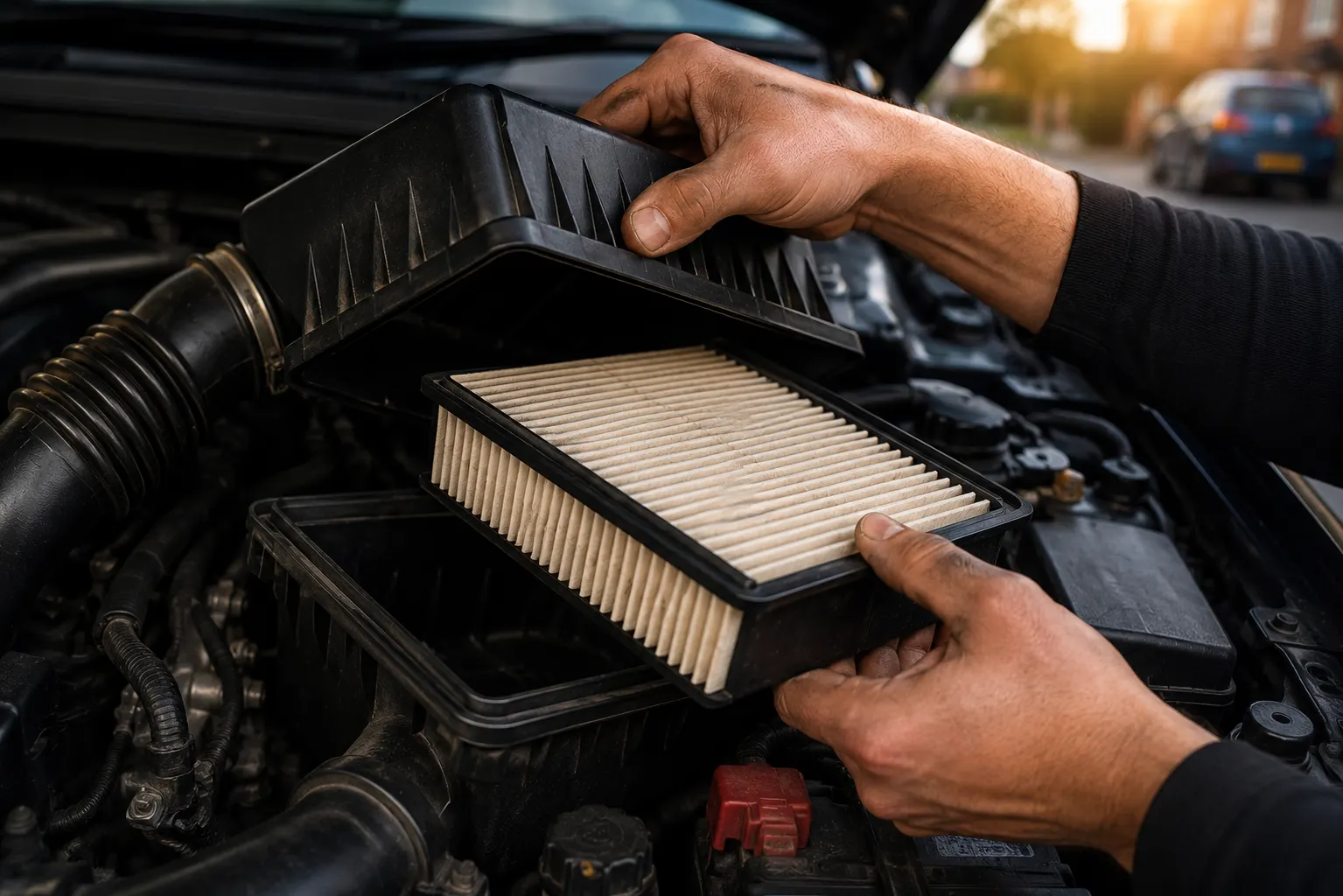
The engine air filter has a simple but important job: it stops dust, dirt, leaves, grit and other debris entering the engine. Over time, it becomes clogged, which can affect airflow, performance and efficiency. Replacing it is often quick, affordable and well within reach for many drivers.
That said, the correct air filter depends on your vehicle, and some modern engine bays are more awkward than others. If the filter housing is buried under plastic covers and wiring, or you are not confident, there is no shame in asking a garage. Pride is cheaper than a broken airbox clip, but only just.
Quick Answer: How Do You Change a Car Air Filter?
To change a car air filter, switch off the engine, open the bonnet, locate the air filter box, remove the clips or screws, take out the old filter, clean any loose debris from the housing, fit the correct replacement filter in the same orientation, then refit the cover securely. Always use the right filter for your make, model and engine.
Useful source: RAC car servicing checklist
What Does a Car Air Filter Do?
A car's engine air filter cleans the air before it enters the engine.
Petrol and diesel engines need a mixture of fuel and air to run properly. If dirty air gets into the engine, it can carry grit and debris that may increase wear over time. The air filter helps protect the engine by trapping contaminants before they reach the intake system.
A clean engine air filter helps support:
- Correct airflow
- Efficient combustion
- Smooth engine running
- Better throttle response
- Protection from dirt and grit
- Longer engine life
- Proper fuel-air mixture
Halfords notes that air filters allow clean air into the engine and help maintain performance and engine lifespan.
Useful source: Halfords car filters explained
Engine Air Filter vs Cabin Filter: What's the Difference?
This is a common source of confusion.
Your car may have more than one "air filter", but they do different jobs.
| Filter Type | What It Does | Who It Helps |
|---|---|---|
| Engine air filter | Cleans air entering the engine | The engine |
| Cabin filter / pollen filter | Cleans air entering the interior through the ventilation system | You and your passengers |
The engine air filter affects the engine. The cabin filter affects the air inside the car.
If your car has poor airflow from the vents, a musty smell or a foggy windscreen, that may be a cabin filter issue rather than an engine air filter problem. If the engine feels sluggish, uses more fuel or the filter looks dirty, the engine air filter may need attention.
Useful source: RAC cabin and pollen filter guide
How Often Should You Change a Car Air Filter?
There is no single interval that applies to every car.
As a rough guide, many vehicles need an engine air filter replacement somewhere between 15,000 and 30,000 miles, but the correct interval depends on your vehicle manufacturer's service schedule. Some cars may need it sooner, especially if they are driven in dusty conditions, heavy traffic or rural areas.
Check:
- Vehicle handbook
- Manufacturer service schedule
- Garage service checklist
- Existing service history
- Filter condition
You may need to replace the air filter more often if you regularly drive:
- On dusty country roads
- Near building sites
- In heavy urban traffic
- In areas with high pollen
- On unmade roads
- In stop-start conditions
- In very dry or sandy environments
A car driven gently on clean roads may not clog its filter as quickly as one spending its life inhaling dust behind lorries and tractors.
Signs Your Car Air Filter Needs Changing
A dirty engine air filter can show up in several ways.
Possible signs include:
- Reduced acceleration
- Engine feeling less responsive
- Poor fuel economy
- Rough running
- Unusual intake noise
- Dirty or dark filter element
- Engine warning light in some cases
- Black smoke from exhaust on some older vehicles
- Service reminder due
However, these symptoms can also be caused by other faults. Do not assume every sluggish car only needs a £15 filter. Sometimes it does. Sometimes the car has bigger plans for your bank account.
The best check is to inspect the filter visually and compare it with the service schedule.
What Tools Do You Need?
For many cars, very little.
You may need:
- Replacement engine air filter
- Screwdriver
- Socket set
- Gloves
- Torch
- Vacuum cleaner or clean cloth
- Vehicle handbook
- Trim tool, on some cars
Some airboxes are held with metal clips and require no tools. Others use screws, bolts or awkward plastic fasteners apparently designed by someone with very small hands and a grudge.
How to Choose the Right Air Filter
Do not buy an air filter just because it looks roughly the same shape.
You need the correct filter for your:
- Make
- Model
- Year
- Engine size
- Fuel type
- Engine code, in some cases
Use:
- Your registration number on a trusted parts website
- Your vehicle handbook
- A motor factor
- A main dealer
- A reputable garage
Check the new filter against the old one before fitting.
It should match:
- Length
- Width
- Depth
- Shape
- Seal design
- Any locating tabs or edges
If it does not sit properly in the airbox, do not force it. An incorrectly fitted air filter can allow unfiltered air into the engine, which defeats the entire point.
Before You Start
Park safely and let the engine cool.
Before changing the air filter:
- Park on level ground.
- Switch off the engine.
- Remove the key.
- Open the bonnet securely.
- Keep loose clothing away from moving parts.
- Avoid touching hot engine components.
- Take a photo of the airbox before removing anything.
A photo is useful because it shows how clips, pipes and covers were positioned before you started. Future you will be grateful.
How to Change a Car Air Filter Step by Step
The exact process varies by car, but most follow the same basic method.
Step 1: Locate the Air Filter Box
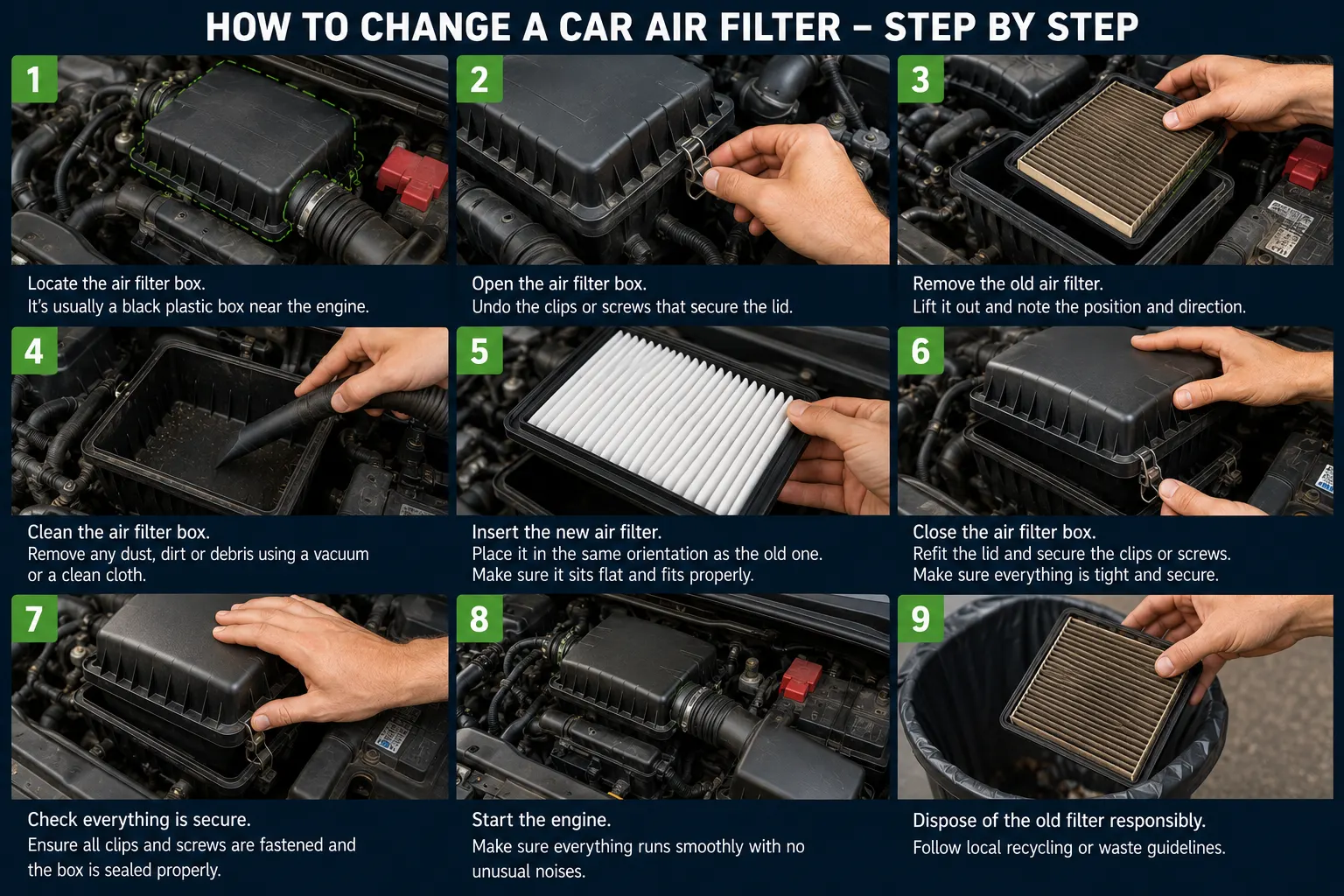
The engine air filter is usually inside a plastic airbox in the engine bay, often connected to a large air intake pipe leading towards the engine. Look for a rectangular or square plastic box, metal clips or screws around the edge, a large intake hose, or a housing near the front or side of the engine bay. If you cannot find it, check your handbook or search for your exact make, model and engine.
Step 2: Open the Airbox
The airbox cover may be held on by spring clips, screws, bolts, plastic tabs, or a combination of all of them. Undo the clips or screws carefully. Do not yank the cover open, since some cars have sensors, pipes or wiring attached nearby, and plastic clips can become brittle with age. If there is a mass airflow sensor connected to the intake pipe, avoid pulling or stressing the wiring.
Step 3: Remove the Old Air Filter
Lift the old air filter out of the housing. Take note of which way up it sits, how the rubber seal fits, whether any tabs locate into grooves, and whether the dirty side faces a particular direction. If you are unsure, take another photo before removing it fully. Inspect the old filter: if it is dark, clogged with debris, full of leaves or visibly dusty, it was ready to retire.
Step 4: Clean the Airbox
Before fitting the new filter, check inside the airbox. You may find dust, leaves, insects, grit or small debris. Use a vacuum cleaner or clean cloth to remove loose debris, being careful not to push dirt into the intake pipe. Do not spray water into the airbox — engines enjoy air, but they are less keen on surprise puddles.
Step 5: Fit the New Air Filter
Place the new filter into the airbox in the same orientation as the old one. Make sure it sits flat, the seal is properly seated, no edges are folded, it matches the housing, there are no gaps, and it is not forced into place. A poor seal can let dirty air bypass the filter. This is one of those jobs where "near enough" is not good enough — the filter must fit properly.
Step 6: Refit the Airbox Cover
Put the airbox cover back into position and secure all clips, screws or bolts. Check that the cover closes evenly, no seal is trapped or twisted, no tools are left in the engine bay, no hoses have been dislodged, and any sensors or plugs remain connected. A loose airbox cover can cause poor running, intake noise or unfiltered air entering the system.
Step 7: Start the Engine
Start the engine and let it idle. Listen for unusual sucking noises, rough idle, warning lights, loose covers or rattles. If everything sounds normal, the job is done. If you get an engine warning light or the car runs badly, switch it off and recheck the airbox, intake hose and any sensor connections.
Common Mistakes to Avoid
Avoid these:
- Buying the wrong air filter
- Fitting the filter upside down or poorly seated
- Leaving clips or screws loose
- Dropping debris into the intake
- Damaging brittle plastic clips
- Pulling on sensor wiring
- Forgetting to reconnect intake hoses
- Using compressed air aggressively near sensors
- Forcing the airbox shut
- Ignoring the manufacturer service schedule
Most problems come from rushing. It is a simple job, but only if done carefully.
Can You Clean an Air Filter Instead of Replacing It?
Usually, replacement is better.
Most standard paper air filters are designed to be replaced, not washed. You can gently tap out loose debris if you are inspecting it, but if it is dirty, clogged or due for replacement, fit a new one.
Do not wash a paper filter and refit it. A damp or damaged filter can restrict airflow or break down.
Some performance filters are washable and reusable, but they require the correct cleaning and oiling process. Over-oiling a reusable filter can contaminate sensors on some cars, especially the mass airflow sensor.
If your car has a standard filter, just replace it with the correct part. It is usually cheap enough that heroic cleaning is not worth the bother.
Does Changing the Air Filter Improve Performance?
It can, if the old filter was dirty or clogged.
A fresh air filter can help restore proper airflow and engine response. However, do not expect a standard replacement filter to turn a family hatchback into a touring car. It will still be your car, just breathing properly.
The main benefit is maintenance, not magic.
A new filter can help with:
- Restoring normal throttle response
- Supporting fuel efficiency
- Reducing intake restriction
- Protecting the engine
- Keeping servicing up to date
If the old filter was already clean, you may not notice much difference.
Does an Air Filter Affect Fuel Economy?
A clogged air filter can affect efficiency, particularly on older vehicles and in certain driving conditions.
Modern fuel-injected cars can compensate for airflow changes to some extent, but a badly restricted filter is still not ideal. The engine has to work with poorer airflow, and performance may suffer.
Even if the fuel saving is modest, replacing a dirty air filter is still worthwhile because it protects the engine.
Can a Dirty Air Filter Cause an MOT Failure?
The engine air filter itself is not usually a direct MOT test item in the same way as tyres, lights or brakes.
However, a badly maintained engine may contribute to emissions problems, poor running or warning lights, which can affect an MOT result depending on the issue.
An MOT is not a service. Passing an MOT does not mean the air filter is clean, the oil is fresh or the car is fully maintained. It only means the vehicle met the minimum test standards at the time.
If your MOT is coming up, a basic service check — including the air filter — is sensible. Need to check your MOT date before booking maintenance? Check when your MOT is due.
How Much Does It Cost to Change a Car Air Filter?
The cost depends on the car and the filter.
As a rough guide:
| Option | Typical Cost |
|---|---|
| DIY standard air filter | Often around £10–£30 for the part |
| Premium or specialist filter | Can cost more |
| Garage replacement | Part cost plus labour |
| Main dealer replacement | Usually more expensive |
Some cars make the job quick and easy. Others take longer because the filter is harder to access.
If the air filter is replaced as part of a service, it may already be included depending on the service level. Always check the service checklist — see our guide on how much a car service costs for a full breakdown.
Useful source: Halfords car filters explained
Should You Change the Cabin Filter at the Same Time?
It can be a good idea, but it is a separate job.
The engine air filter protects the engine. The cabin filter protects the air entering the cabin through the heating and ventilation system.
A cabin filter may need replacing if you notice:
- Weak airflow from vents
- Musty smells
- Foggy windscreen
- Poor air-con performance
- More dust or pollen inside the car
RAC advises cabin or pollen filters are often changed every 12 to 18 months or every 10,000–15,000 miles, but you should follow your vehicle handbook.
If a foggy windscreen sounds familiar, it is worth reading our guide on how to stop car windows fogging up, since a blocked cabin filter is one of the common causes.
Should You Change the Air Filter Before Selling a Car?
It can help if the car is due a service or the filter is visibly dirty.
A clean, recently serviced car is more appealing to buyers. More importantly, service receipts show the car has been looked after.
If you are buying or selling a used car, it is also worth checking the vehicle's MOT record and general condition — see our guide on what to check when buying a used car. A MOT health check can help review MOT history, mileage records and previous defects before money changes hands.
When Should You Use a Garage Instead?
Use a garage if:
- You cannot locate the air filter
- The airbox is difficult to access
- Clips or screws are seized
- The car has warning lights
- You are unsure which filter is correct
- The intake system has sensors you may damage
- The vehicle is under warranty and you want service records
- You are not confident
There is no prize for doing everything yourself. A five-minute job on one car can be a frustrating plastic-breaking contest on another. It is also worth keeping other fluids topped up between services — check out our guide on what coolant your car needs.
FAQs
How do I change a car air filter?
Open the bonnet, locate the engine air filter box, remove the clips or screws, lift out the old filter, clean loose debris from the housing, fit the correct new filter in the same position and secure the airbox cover properly.
How often should I change my car air filter?
Many vehicles need an engine air filter around every 15,000–30,000 miles, but intervals vary. Always follow your vehicle handbook or manufacturer service schedule.
Can I change an air filter myself?
Yes, many drivers can change an engine air filter themselves. It is usually a simple job, but some cars have awkward airbox locations or fragile clips, so use a garage if unsure.
Is the engine air filter the same as the cabin filter?
No. The engine air filter cleans air entering the engine. The cabin filter, also called a pollen filter, cleans air entering the car's interior through the ventilation system.
What happens if I do not change my air filter?
A dirty air filter can restrict airflow, reduce engine response, affect efficiency and allow the engine to work harder than it should. If neglected badly, it may contribute to poor running.
Can I drive with a dirty air filter?
You can usually drive with a dirty air filter for a while, but it is not wise to ignore it. If the filter is badly clogged, replace it as soon as possible.
Can I clean a paper air filter?
You can gently remove loose debris, but standard paper air filters are designed to be replaced, not washed. If it is dirty or due for replacement, fit a new one.
Will a new air filter make my car faster?
Not dramatically. If the old filter was clogged, a new one may restore normal response. A standard replacement filter will not significantly increase power on a normal road car.
Can the wrong air filter damage my car?
Yes. If the filter does not fit properly, it may allow unfiltered air into the engine or restrict airflow. Always use the correct filter for your exact vehicle.
Is an air filter changed during a service?
Often, yes, but not always. A full or major service may include an air filter replacement, while an interim service may only inspect it. Check the garage's service checklist.
Conclusion
Changing a car air filter is one of the more approachable DIY maintenance jobs. Use the correct replacement filter, fit it carefully, make sure the airbox is properly sealed and follow your vehicle's service schedule.
A clean air filter helps your engine breathe properly, supports efficiency and protects internal components from dirt and debris. It will not transform your car into a racing machine, but it is cheap, sensible maintenance — which, in the world of motoring, is often the best kind.