
How to Check Oil Level in a Car
Learn how to check your car’s oil level, read the dipstick, top up safely, choose the correct oil and avoid overfilling your engine.
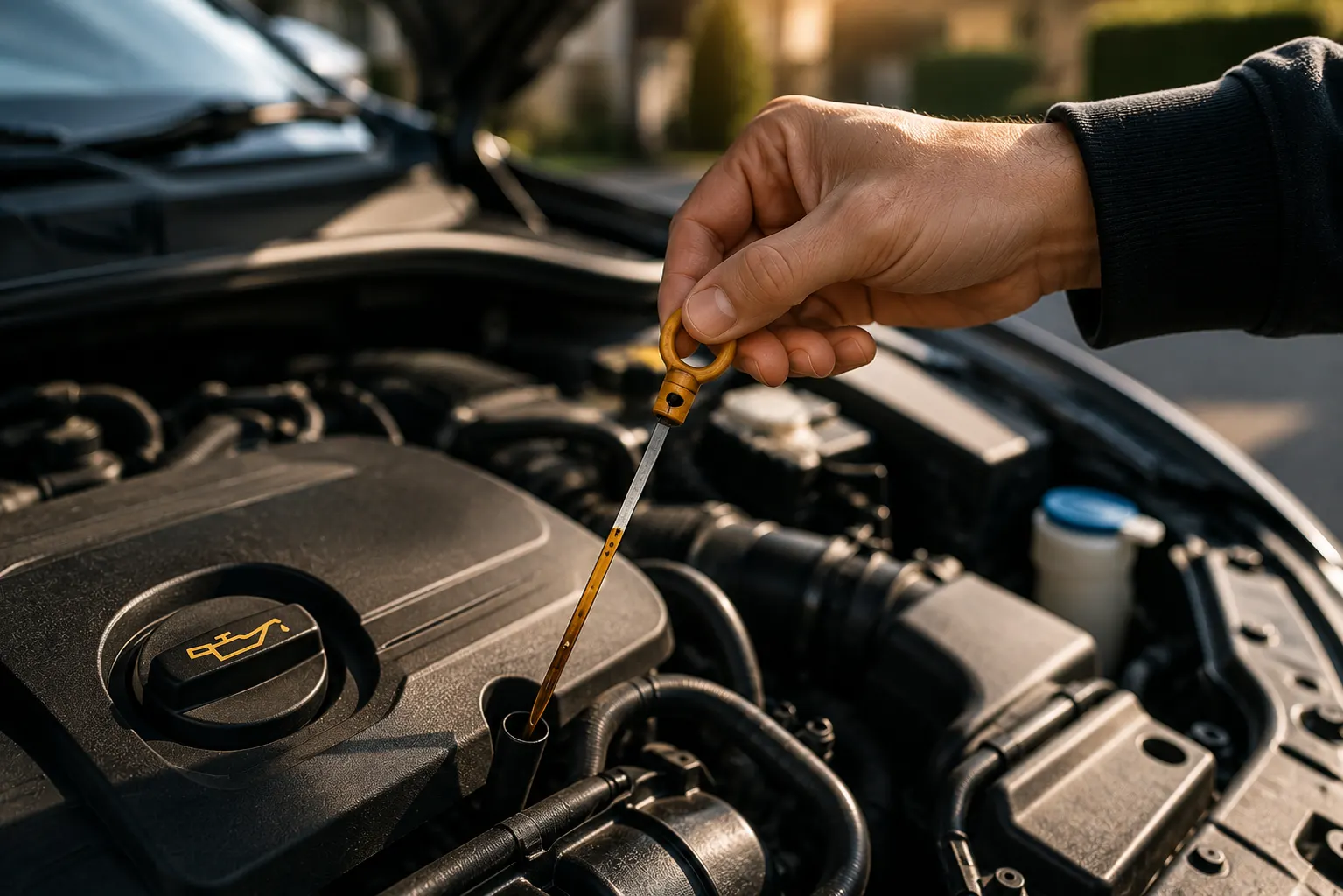
Checking your car’s oil level is one of the simplest bits of maintenance you can do, but it is also one of the most important. Engine oil lubricates, cools and protects the moving parts inside your engine. Too little oil can cause serious damage. Too much oil can also cause problems. So yes, the humble dipstick deserves a little respect.
The good news is that checking oil level is usually quick. Park on level ground, switch the engine off, let the oil settle, pull the dipstick, wipe it clean, reinsert it, pull it out again and check the level sits between the minimum and maximum marks.
Some modern cars do not have a traditional dipstick and instead use an electronic oil level display. The principle is the same: check the level regularly and top up only with the correct oil for your car.
Quick Answer: How Do You Check Oil Level in a Car?
To check oil level in a car, park on level ground, switch off the engine and wait a few minutes for the oil to settle. Pull out the dipstick, wipe it clean, push it fully back in, then pull it out again. The oil should sit between the minimum and maximum marks. If it is low, top up slowly with the correct engine oil and recheck.
Useful source: AA engine oil checking guide
Why Checking Engine Oil Matters
Engine oil has several important jobs.
It helps:
- Lubricate moving engine parts
- Reduce friction
- Control engine temperature
- Protect against wear
- Keep internal parts cleaner
- Prevent metal-on-metal contact
- Support smooth engine running
If the oil level gets too low, the engine may not be properly lubricated. That can lead to overheating, increased wear, noisy running, warning lights and expensive damage.
If the oil level is too high, that can also cause issues. Overfilled oil can foam, increase pressure inside the engine and potentially damage seals or internal components.
In short, oil level is not one of those things to check “when you remember in 2029”. It is basic car care.
When Should You Check Your Oil Level?
You should check your oil level regularly, especially:
- Before a long journey
- Before a motorway trip
- Before towing
- Before a holiday drive
- If the oil warning light appears
- If the engine sounds noisier than usual
- If you notice oil stains under the car
- If the car is using more oil than normal
- Before an MOT or service
- After topping up, to make sure the level is correct
The AA recommends checking oil every few weeks and especially before long journeys. Your vehicle handbook will give the correct advice for your specific car.
Useful source: GOV.UK vehicle safety checks
Should the Engine Be Hot or Cold?
For most cars, the safest general advice is to check the oil when the engine is cold or has been switched off for several minutes.
The AA advises parking on level ground and checking before using the car, or waiting around 5–10 minutes after driving so the oil can drain back into the sump.
A hot engine can also burn you if you touch the wrong part. Engines are inconsiderate like that.
Always check your handbook because some vehicles have specific oil-checking procedures, especially those with electronic oil level systems.
What You Need to Check Engine Oil
You may need:
- Clean cloth or paper towel
- Gloves
- Funnel
- Correct engine oil
- Vehicle handbook
- Torch, if visibility is poor
A funnel is not essential, but it helps avoid spills. Engine bays are already grubby enough without you adding modern art in 5W-30.
How to Check Oil Level with a Dipstick
Most cars with a dipstick follow this process.
Step 1: Park on Level Ground
Park the car on flat, level ground. Do not check oil on a slope. If the car is tilted, the oil level reading may be inaccurate. Switch off the engine and wait a few minutes if the car has just been driven.
Step 2: Open the Bonnet
Open the bonnet and secure it properly. Make sure the car is switched off. Do not check anything under the bonnet with the engine running unless your handbook specifically tells you to for a particular procedure.
Step 3: Find the Dipstick
Look for the dipstick handle in the engine bay. It is often yellow, orange or red, clearly marked, and near the front or side of the engine. If you cannot find it, check your vehicle handbook. Some modern cars do not have a physical dipstick.
Step 4: Pull Out the Dipstick and Wipe It Clean
Pull the dipstick out fully. It will usually be covered in oil, so that first pull is not the reading you want. Wipe it clean with a cloth or paper towel. This gives you a fresh, accurate reading when you reinsert it.
Step 5: Reinsert the Dipstick Fully
Push the dipstick all the way back into its tube. Make sure it is fully seated. If it is not pushed in properly, the reading may be wrong.
Step 6: Pull It Out Again and Read the Level
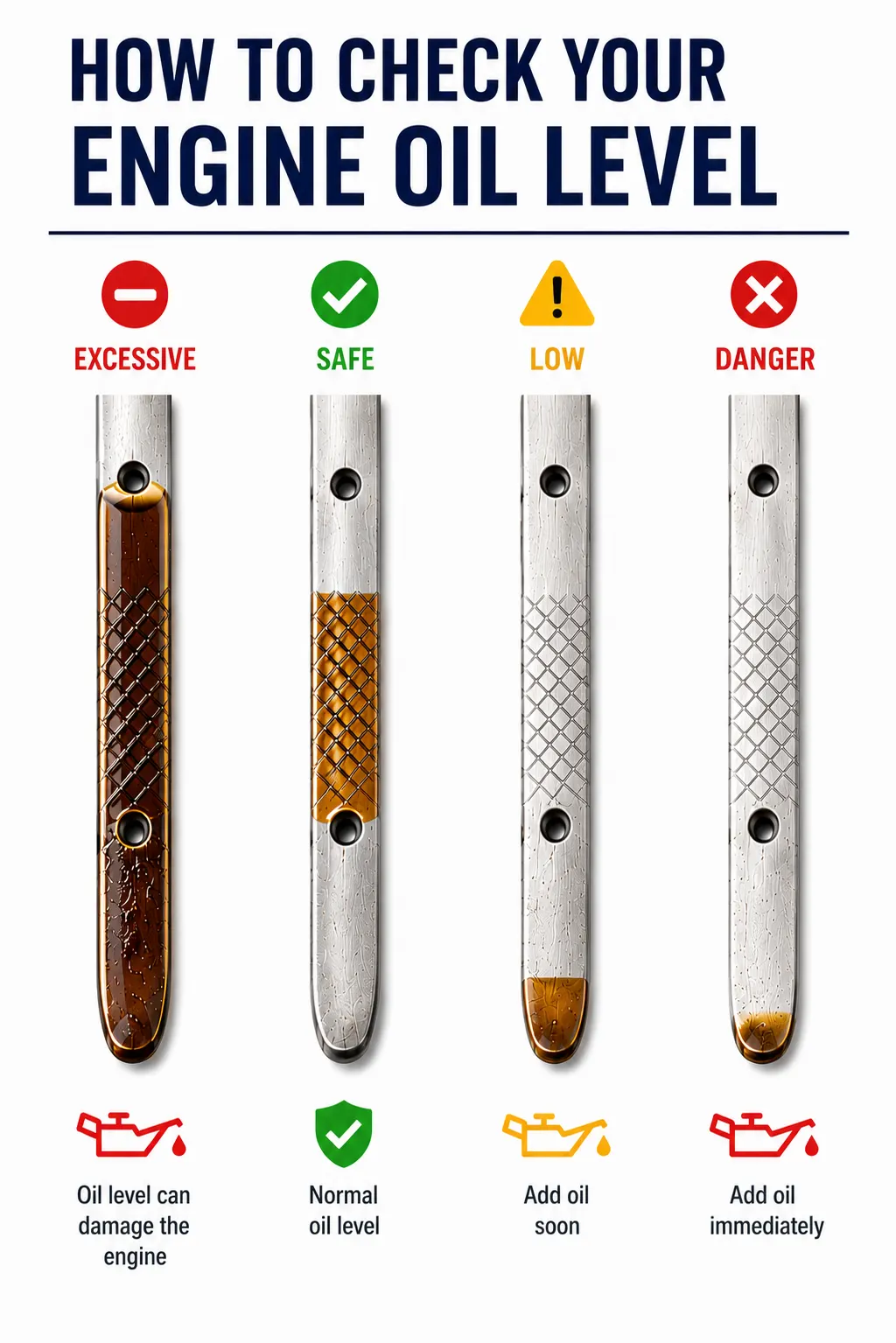
Pull the dipstick out again and look at the oil mark. Most dipsticks have a minimum mark, a maximum mark, two holes, two lines or a crosshatched area, often labelled “Min” and “Max”. The oil level should be between the minimum and maximum marks.
| Dipstick Reading | What It Means |
|---|---|
| Near maximum | Usually fine |
| Around halfway | Usually fine |
| Below halfway | May need a small top-up |
| Near minimum | Top up soon |
| Below minimum | Top up before driving if safe to do so |
| Above maximum | Too much oil; may need draining |
Do not panic if it is not exactly on the maximum mark. Between minimum and maximum is generally the target.
Useful source: RAC oil checking advice
How to Top Up Engine Oil
If the oil level is low, top it up carefully.
1. Use the Correct Oil
Before adding anything, make sure you have the correct engine oil. Check your vehicle handbook, the oil filler cap if marked, the manufacturer specification, service records, a trusted oil finder tool, or ask a garage or dealer.
The grade, such as 5W-30 or 0W-20, is only part of the story. The oil also needs to meet the correct manufacturer specification. Using the wrong oil can damage the engine or affect warranty cover.
2. Find the Oil Filler Cap
The oil filler cap is usually on top of the engine. It may show the word “oil”, an oil can symbol, or the recommended oil grade on some vehicles. Remove the cap carefully and place it somewhere clean.
3. Add Oil Slowly
Add a small amount at a time. Do not pour in a whole litre unless you are sure that is needed. The AA notes that the difference between minimum and maximum on many dipsticks is about one litre, but if you are unsure, add a little, wait and recheck.
A sensible approach is:
- Add a small amount.
- Wait a minute or two.
- Recheck the dipstick.
- Repeat if needed.
Do not overfill. Too much oil can be just as bad as too little.
4. Refit the Cap and Dipstick
Once the level is correct, refit the oil filler cap securely, reinsert the dipstick fully, wipe away any spilled oil and close the bonnet properly. If you spill oil on hot engine components, it can smell unpleasant and may smoke. Clean spills before driving.
How Much Oil Should You Add?
The amount depends on the engine and the dipstick reading.
As a rough guide, many dipsticks show about one litre between the minimum and maximum marks, but this is not universal.
If the oil is just below halfway, you may only need a small top-up. If the oil is near or below minimum, you may need more.
The safest method is not to guess. Add oil gradually and recheck.
The engine is not a pint glass. Do not fill it to the brim.
What Oil Does My Car Need?
Your car needs the oil grade and specification recommended by the manufacturer.
Common oil grades include:
- 0W-20
- 0W-30
- 5W-30
- 5W-40
- 10W-40
But the numbers alone are not enough. Some engines require oil that meets specific standards, such as manufacturer approvals or ACEA/API specifications.
Check your owner’s manual, service book, manufacturer website, dealer advice, or a reputable oil finder using your registration.
If two bottles both say 5W-30, they may still not both be right for your engine.
Useful source: RAC guide to choosing engine oil
What If Your Car Has No Dipstick?
Some modern cars do not have a traditional dipstick. Instead, they use an electronic oil level display through the dashboard or infotainment system.
The process varies by car, but usually involves parking on level ground, having the engine at the required temperature, switching the engine off or leaving it idling depending on the vehicle, waiting for the car to measure the level, and reading the display.
Always follow the handbook. Some electronic systems are fussy and will not give a reading unless the car is level, warm enough or stationary for long enough.
Halfords notes that some vehicles do not have a dipstick and require oil level checks through the vehicle information display.
Useful source: Halfords oil level guide
What Should the Oil Look Like?
When checking the dipstick, look at the oil condition as well as the level.
Normal oil may be golden brown, brown, dark brown, or black, especially in diesel engines.
Dark oil does not always mean disaster. Diesel engine oil can turn black quickly because it holds soot and contaminants in suspension.
Warning signs include:
- Milky or creamy oil
- Thick sludge
- Gritty texture
- Metallic particles
- Strong burnt smell
- Oil level rising unexpectedly
- Oil mixed with coolant
- Coolant mixed with oil
Milky oil can sometimes indicate coolant contamination, though short-trip condensation can also cause light residue under the filler cap. If you see milky oil on the dipstick, coolant loss or overheating, get the car checked. If you’re unsure what coolant your car needs after checking, see our guide on what coolant does my car need.
What Does the Oil Warning Light Mean?
An oil warning light should be taken seriously.
There are different types of warning:
| Warning | Meaning |
|---|---|
| Oil level warning | Oil level may be low |
| Oil pressure warning | Oil pressure may be dangerously low |
| Service oil message | Oil change or service may be due |
An oil pressure warning is urgent. If it appears while driving, stop somewhere safe as soon as possible, switch off the engine and check the handbook. Do not keep driving and hope it goes away.
Low oil pressure can damage an engine very quickly.
If the warning light stays on after topping up, do not continue driving. Get professional help.
Symptoms of Low Engine Oil
Signs of low oil can include:
- Oil warning light
- Noisy engine
- Ticking or knocking sounds
- Burning oil smell
- Engine overheating
- Poor performance
- Smoke from the exhaust
- Oil stains under the car
- Frequent need to top up
Some cars give no obvious symptoms until the problem is serious. That is why checking manually still matters.
A silent engine is not always a healthy engine. Sometimes it is just waiting to send you a very expensive invoice.
What If the Oil Level Keeps Dropping?
If you keep needing to top up oil, find out why. Possible causes include:
- Oil leak
- Worn piston rings
- Worn valve stem seals
- Turbocharger issue
- PCV system fault
- Incorrect oil grade
- High mileage engine wear
- Hard driving
- Manufacturer-specific oil consumption issues
Some engines use a little oil between services. But if you are topping up often, do not ignore it.
Look for oil spots on the driveway, a burning oil smell, blue smoke from the exhaust, wet oil around the engine, oil around the turbo area, or oil on the undertray.
Take the car to a garage if the level keeps falling or if you see smoke, leaks or warning lights. As part of your wider checks when buying a used car, always inspect the engine bay for oil residue or leaks.
Can an Oil Leak Affect an MOT?
Yes, if it is serious enough.
An MOT is not the same as a service, and GOV.UK makes clear that the MOT does not check the general mechanical condition of the engine, clutch or gearbox. However, the MOT inspection manual includes fluid leak checks.
A vehicle can fail if a fluid leak creates a pool on the floor within 5 minutes that is more than 75mm in diameter, or if multiple leaks collectively leak at that rate. A continuous leak likely to pose a serious road safety risk can be classed as dangerous.
Useful source: MOT inspection manual: fluid leaks
So a slight oil mist may not necessarily fail an MOT, but an excessive leak can.
If you are buying a used car and the MOT history mentions leaks, undertrays, emissions issues or repeated advisories, take it seriously. Use the MOTChecker.com vehicle health check to review MOT history, mileage records and previous defects before you buy.
Can Low Oil Affect an MOT?
It can affect whether certain parts of the MOT can be carried out safely.
For diesel vehicles, the DVSA MOT inspection manual says the smoke test should not be carried out if there is insufficient oil in the engine, low engine oil pressure or abnormal engine noise.
This is another reason not to turn up for an MOT with a neglected engine and a prayer.
Useful source: MOT inspection manual: emissions and oil condition
Should You Check Oil Before a Long Journey?
Yes.
Before a long journey, check engine oil, coolant, tyres, screen wash, lights, brake fluid if accessible, windscreen and wipers, and fuel or charge level.
Oil is especially important before motorway trips because the engine may be working for long periods at sustained speed.
If the oil is already low before you leave, a long journey can make the situation worse.
Should You Check Oil Before or After Filling Fuel?
You can check oil at a petrol station if needed, but make sure the car is parked level and the engine has been switched off for a few minutes.
Petrol station forecourts are not always perfectly level, so treat the reading with some caution.
For the most accurate regular check, do it at home on level ground before driving.
Can You Mix Engine Oil Brands?
Usually, topping up with a different brand is less important than using the correct grade and specification.
However, the safest option is to use oil that matches the manufacturer’s specification. Do not mix random oils just because the bottles look similar.
In an emergency, adding the best available suitable oil may be better than driving with dangerously low oil. But after that, check the handbook and have the car serviced or inspected if needed. If you’re due a service anyway, it’s worth knowing how much a car service costs so you can budget for it.
Common Mistakes to Avoid
Avoid these:
- Checking oil on a slope
- Reading the dipstick without wiping it first
- Checking with the engine running
- Overfilling the engine
- Using the wrong oil
- Ignoring the oil warning light
- Forgetting to refit the oil cap
- Spilling oil and leaving it on the engine
- Assuming an MOT is the same as a service
- Ignoring repeated oil loss
- Driving with oil below minimum
- Thinking black diesel oil always means disaster
Most oil-checking mistakes come from rushing. Take two extra minutes and save yourself from a very expensive engine-shaped problem. It’s also worth adding oil checks to your routine alongside changing your air filter and checking your battery, since these simple checks all help keep your engine bay in good health.
FAQs
How do I check oil level in a car?
Park on level ground, switch off the engine, wait a few minutes, remove the dipstick, wipe it clean, reinsert it fully, pull it out again and check the oil mark. It should sit between the minimum and maximum marks.
Should I check oil when the engine is hot or cold?
For most cars, check oil when the engine is cold or after it has been switched off for several minutes. Some vehicles have specific instructions, so always check the handbook.
Where should oil be on the dipstick?
The oil should be between the minimum and maximum marks. Around halfway or above is usually fine. If it is near or below the minimum mark, top up with the correct oil.
How much oil should I add if it is low?
Add oil slowly and recheck. Many dipsticks have around one litre between minimum and maximum, but this varies by car. Do not pour in too much at once.
What happens if I overfill engine oil?
Too much oil can cause foaming, pressure issues, leaks and possible engine damage. If the oil is above the maximum mark, get advice before driving far.
What oil does my car need?
Use the oil grade and specification recommended in your vehicle handbook. The viscosity, such as 5W-30, is only part of the requirement; the oil must also meet the correct technical specification.
What if my car has no dipstick?
Some modern cars use an electronic oil level display. Park on level ground and follow the handbook instructions to get an accurate reading through the dashboard or infotainment system.
Is dark oil bad?
Not always. Oil naturally darkens with use, especially in diesel engines. However, gritty, sludgy, milky or burnt-smelling oil should be checked by a garage.
Can I drive with low oil?
If the oil is below minimum or an oil warning light is on, avoid driving until the level has been corrected and the issue checked. Low oil can cause serious engine damage.
Does an MOT check engine oil?
An MOT is not a service and does not check the general mechanical condition of the engine. However, very low oil or serious leaks can affect testing and roadworthiness.
Conclusion
Checking your car’s oil level is quick, simple and genuinely useful. Park on level ground, switch off the engine, wipe and recheck the dipstick, then make sure the oil sits between the minimum and maximum marks.
If it is low, top up slowly with the correct oil. If it keeps dropping, smells burnt, looks contaminated or triggers warning lights, get the car checked. Oil is cheap compared with engine repairs, and a two-minute check can save you from a four-figure headache.